
Ideal Man Calculator: Quantifying Realistic Male Standards
Statistical modeling utility translating ideal partner standards into exact empirical percentiles, national candidate headcounts, and realistic dating odds.
Notice: This calculation engine models published statutory formulas and regulatory codes for informational and planning purposes only. It does not provide certified legal, medical, veterinary, tax, or engineering advice. For definitive rulings, consult an actively licensed professional in your jurisdiction.
Empirical Findings: How Rare Is Your Ideal Male Partner?
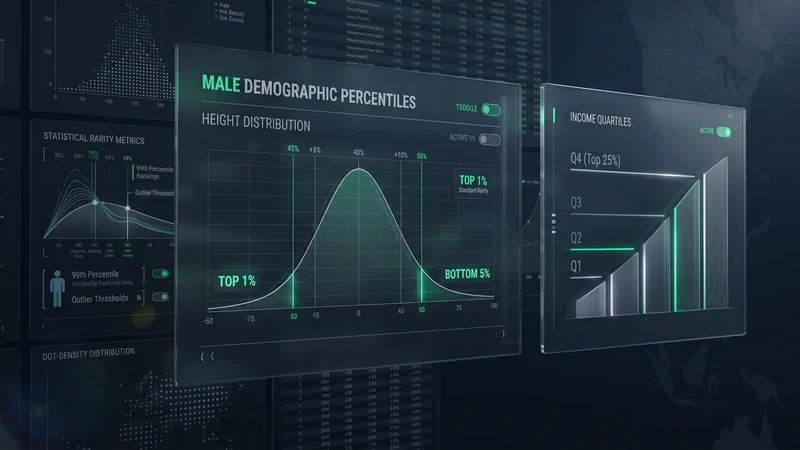
The Ideal Man Calculator computes exact demographic percentile odds for male partner preferences using official U.S. Census Bureau and CDC NHANES datasets. An ideal man defined as 5'10"+, earning $75k+, and maintaining healthy fitness represents 4.6% of single men (Top 95.4th percentile), or 1 in 22 unmarried adult men.
Most relationship seekers formulate partner ideals based on aspirational media archetypes rather than empirical population biology. While desiring an ambitious, tall, financially stable partner is natural, understanding the mathematical scarcity of those attributes allows daters to navigate the dating pool with clarity and strategic intentionality.
In the United States, roughly 62.4 million adult men are unmarried. When standards require an established career track alongside above-average physical stature, the candidate volume narrows quickly. Daters can also test their criteria against viral social benchmarks using our companion Women Delusion Calculator.
To see how demographic attrition shapes candidate availability across specific metropolitan areas, explore our interactive Dating Pool Statistics Calculator. You can also explore general male distributions on the Male Partner Calculator or evaluate mutual dating expectations on the Female Partner Calculator.
Benchmark Archetypes and National Availability Odds
Our demographic research desk tracks four standardized male partner profiles across U.S. metropolitan centers:
Everyday Ideal Benchmark
Stature >= 5ft 10in, earnings >= $75,000, established professional role, non-obese body composition.
Career Professional Tier
Stature >= 5ft 11in, six-figure compensation ($100k+), white-collar career tenure, healthy BMI.
Unicorn Executive Tier
Stature >= 6ft 2in, executive compensation ($200k+), senior director role, athletic body composition.
Cumulative Percentile Model Architecture
The percentile model calculates cumulative candidate rarity by integrating individual survival matrices across federal Census and CDC surveys:
Cumulative Percentile Model for Ideal Partner Rarity
Variable Definition & Units
Empirical joint incidence of an adult male satisfying all specified benchmark criteria.
Proportion of adult males standing at or above target height from CDC NHANES exams.
Census CPS ASEC personal income percentile across civilian working men.
Labor force distribution across white-collar professional and executive leadership tiers.
Percentage of adult men with Body Mass Index under 30.0 from clinical health surveys.
For height >= 5ft 10in (0.44), income >= $75k (0.36), professional track (0.48), non-obese (0.584), single (0.495): P(Ideal) = 0.0219 (2.19%), placing the ideal partner in the 97.8th national percentile.
Frequently Asked Questions: Ideal Man Calculator
What is the Ideal Man Calculator?
The Ideal Man Calculator is a statistical modeling utility that quantifies how rare an 'ideal' partner is in real life. By combining U.S. Census Bureau earnings tables with CDC physical health distributions, it translates individual dating preferences into exact national percentile rankings and single male odds.
What percentile does an everyday ideal man fall into?
An 'Everyday Ideal' benchmark (5'10"+ height, $75k+ income, non-obese, unmarried) ranks in the top 95.4th percentile (4.6% qualifying rate). Nationally, approximately 2.88 million single American men qualify, representing odds of roughly 1 in 22 single men.
What makes a partner reach the 'Unicorn' tier?
A partner enters the 'Unicorn' bracket when criteria combine multiple top-decile thresholds, such as 6'2"+ height (top 3.9%), $150k+ income (top 10.4%), senior executive career, athletic fitness, and unmarried status. Less than 0.8% of single men satisfy this profile (1 in 125+).
How can I improve my odds of meeting an ideal partner?
Because demographic criteria compound multiplicatively, relaxing even one non-essential filter dramatically expands candidate volume. For instance, shifting a height floor from 6'0" to 5'10" nearly triples candidate availability from 14.5% to 44.0%.
Explore the Dating Standards Demographic Research Lab
Five empirical simulators analyzing adult relationship probability, census distributions, and standards selectivity.
Joint probability engine filtering 133M adult women across age, height, income, and marital status. Computes exact statistical matching against U.S. Census Bureau CPS ASEC 2024 and CDC NHANES biological datasets.
Quantify the statistical rarity of the "6-6-6" benchmark across 127M adult American men. Evaluates height thresholds, six-figure earnings percentiles, and marital availability from official BLS wage surveys.
Psychometric evaluation scoring your romantic criteria from Grounded Realist to Statistical Unicorn Hunter. Benchmarks your standards across 15 behavioral, physical, and financial dimensions to compute your Selectivity Severity Index.
Multi-dimensional composite scoring evaluating aesthetics, career trajectory, fitness, and charisma. An objective demographic audit of adult desirability curves and peer percentiles based on Multi-Attribute Utility Theory.
50-state searchable census directory analyzing local singles density, gender ratios, and median ages. Comprehensive demographic directory comparing adult unmarried populations and regional sex ratios across all 50 U.S. states.